 ediaX
By

The best NFT advertising networks to shortlist in 2026 are Coinzilla, Bitmedia, Cointraffic and A-ADS—but choose by campaign fit, not an unsupported performance ranking. For press release distribution rather than paid ad placements, MediaX serves crypto and Web3 projects; it belongs in your launch communications plan, not in a list of advertising networks.
- The best NFT advertising networks shortlist includes Coinzilla, Bitmedia, Cointraffic and A-ADS; compare placement fit before committing.
- Coinzilla and Cointraffic belong on a crypto publisher advertising shortlist; request placement details before choosing.
- Bitmedia is an option for crypto advertising; compare its proposed campaign against your conversion requirements.
- MediaX is best for NFT teams seeking press release distribution, not an advertising network.
Why this matters
An NFT campaign needs more than exposure to people who recognize the word crypto. You need placements that match your collection, game or membership product—and a landing page that explains what someone should do next.
Advertising and PR also solve different problems. Paid placements distribute promotional messages; press releases communicate announcements. Neither proves demand for an NFT project, and neither replaces a working purchase or registration journey.
For your 2026 plan, separate those jobs before comparing proposals. Otherwise, a large placement list can distract you from whether the campaign reaches prospective users and produces a measurable action.
What makes the best NFT advertising networks?
Use these criteria before accepting a recommendation or signing a campaign agreement:
- Audience fit: Ask which proposed publishers serve NFT collectors, blockchain gamers, developers or the specific audience your project needs.
- Placement visibility: Request publisher examples, ad formats and placement exclusions. A network name alone does not tell you where an ad will appear.
- Creative eligibility: Confirm that your NFT project, landing page and promotional claims meet the network’s current requirements.
- Measurement: Define the conversion event, tracking method and reporting fields before launch. Clicks alone do not establish acquisition quality.
- Campaign control: Ask how targeting, creative changes, exclusions and campaign pauses work under the proposed arrangement.
- Delivery accountability: Put creative approval dates, the launch window and reporting responsibilities in writing.
These are selection criteria, not claims that every network provides every capability. Your final choice depends on the written proposal and current campaign terms.
NFT advertising networks at a glance
The table assigns each option a different evaluation role. It does not claim that one network delivers better results than another.
| Network | Best for | Standout role in your shortlist | Key limitation to resolve |
|---|---|---|---|
| Coinzilla | Starting a crypto publisher display campaign | Crypto-focused advertising option | Confirm NFT-relevant placements rather than assuming all crypto audiences fit |
| Bitmedia | Comparing proposals around a defined conversion goal | Alternative crypto advertising route | Confirm tracking, optimization and reporting against your requirements |
| Cointraffic | Evaluating a publisher-led placement proposal | Additional crypto advertising network to assess | Verify the proposed inventory and exclusions |
| A-ADS | Assessing a Bitcoin-oriented advertising route | Bitcoin advertising context | Establish relevance to your NFT audience and payment workflow |
No network wins every use case. For an NFT collection, audience relevance matters more than a familiar publisher name; for a blockchain game, the campaign also needs to explain the playable experience.
1. Coinzilla: best for a crypto display advertising shortlist
Coinzilla is a crypto advertising network to evaluate when you want paid exposure across crypto-focused publishing environments. Start with a concrete placement brief, not a request for the broadest possible campaign.
Best for: NFT teams beginning their comparison of crypto publisher display advertising. Ask Coinzilla to explain how the proposed placements connect to your audience and campaign objective.
Coinzilla pros:
- Its crypto advertising focus makes it relevant to an initial sector-specific shortlist.
- A publisher-based campaign gives you a concrete placement proposal to assess.
- Display advertising provides a format for testing a clear visual message and call to action.
Coinzilla cons:
- Crypto interest does not establish interest in your particular NFT project.
- A publisher’s reputation does not prove that a specific placement will convert.
- You still need to validate campaign eligibility, measurement and placement details.
For a 2026 launch, submit the actual landing page and creative concept during the enquiry. A proposal built around those materials is more useful than a generic description of network reach.
Verdict: Hold until Coinzilla confirms audience fit, eligible creative and the proposed placement scope.
2. Bitmedia: best for a conversion-led campaign comparison
Bitmedia is another crypto advertising option for NFT teams considering paid acquisition. Include it when you want competing proposals assessed against the same business goal rather than against different definitions of exposure.
Best for: Teams that already know the action they want visitors to complete. That action might be a qualified registration, a game account creation or a completed purchase, depending on the project.
Bitmedia pros:
- Its crypto advertising focus makes it a relevant alternative to general advertising channels.
- A separate proposal gives you another approach to compare against the same brief.
- A conversion-led brief keeps the buying discussion tied to your intended user action.
Bitmedia cons:
- A conversion objective is useful only if your tracking captures it correctly.
- Ad clicks and wallet connections are not equivalent to completed purchases.
- Campaign controls and reporting need confirmation rather than assumption.
Ask Bitmedia which reporting fields would let your team distinguish ad engagement from meaningful progression. Keep your own analytics definitions consistent across every proposal you compare.
Verdict: Hold until Bitmedia’s proposed measurement matches your conversion goal.
3. Cointraffic: best for reviewing a publisher-led proposal
Cointraffic belongs on the shortlist when you want another crypto advertising network to present a placement plan. Evaluate the actual proposal rather than treating the network’s name as evidence of NFT audience quality.
Best for: NFT marketing teams prepared to examine publisher relevance, creative context and exclusions before approving distribution.
Cointraffic pros:
- Its crypto advertising focus makes it relevant to a sector-specific buying process.
- A placement-led proposal supports a direct discussion about audience context.
- An additional network proposal helps expose differences in campaign scope.
Cointraffic cons:
- A broad crypto audience is not automatically a collector or gaming audience.
- Publisher examples do not establish the final placement mix unless confirmed.
- Different proposal formats can make like-for-like comparison difficult.
Ask Cointraffic to distinguish confirmed campaign inclusions from illustrative examples. Then request the same clarification from every other shortlisted provider; otherwise, you are comparing commitments with possibilities.
Verdict: Hold until Cointraffic documents the placement scope and reporting responsibilities.
4. A-ADS: best for assessing a Bitcoin-oriented route
A-ADS is an advertising option associated with Bitcoin advertising. Include it when that context is relevant to your audience, rather than assuming that every NFT campaign belongs in the same crypto media environment.
Best for: NFT teams with a clear reason to reach a Bitcoin-oriented audience. Confirm current campaign eligibility and operational requirements directly.
A-ADS pros:
- It adds a Bitcoin-oriented option to a broader crypto advertising shortlist.
- Its different context prompts a useful audience-fit comparison.
- It gives you another route to assess against the same campaign brief.
A-ADS cons:
- Bitcoin audience interest does not establish demand for your NFT proposition.
- Payment and reporting workflows need checking against your internal processes.
- Your landing page must explain the project without assuming familiarity with its ecosystem.
Do not add A-ADS merely to make the shortlist longer. Include it only when you can explain why its advertising context matches the people you want to reach.
Verdict: Skip unless the Bitcoin-oriented context fits your intended audience.
How this shortlist is ranked
The 2026 ordering follows buying tasks: start with crypto display advertising, compare against a conversion-led brief, inspect another publisher proposal, then assess a Bitcoin-oriented alternative.
It is not a measured performance league table. The criteria are audience relevance, placement clarity, creative eligibility, measurement, control and delivery accountability—not claimed returns, assumed traffic quality or publication prestige.
Request proposals using the same brief. Only then can you make a defensible choice for your project.
Build a campaign brief before choosing a network
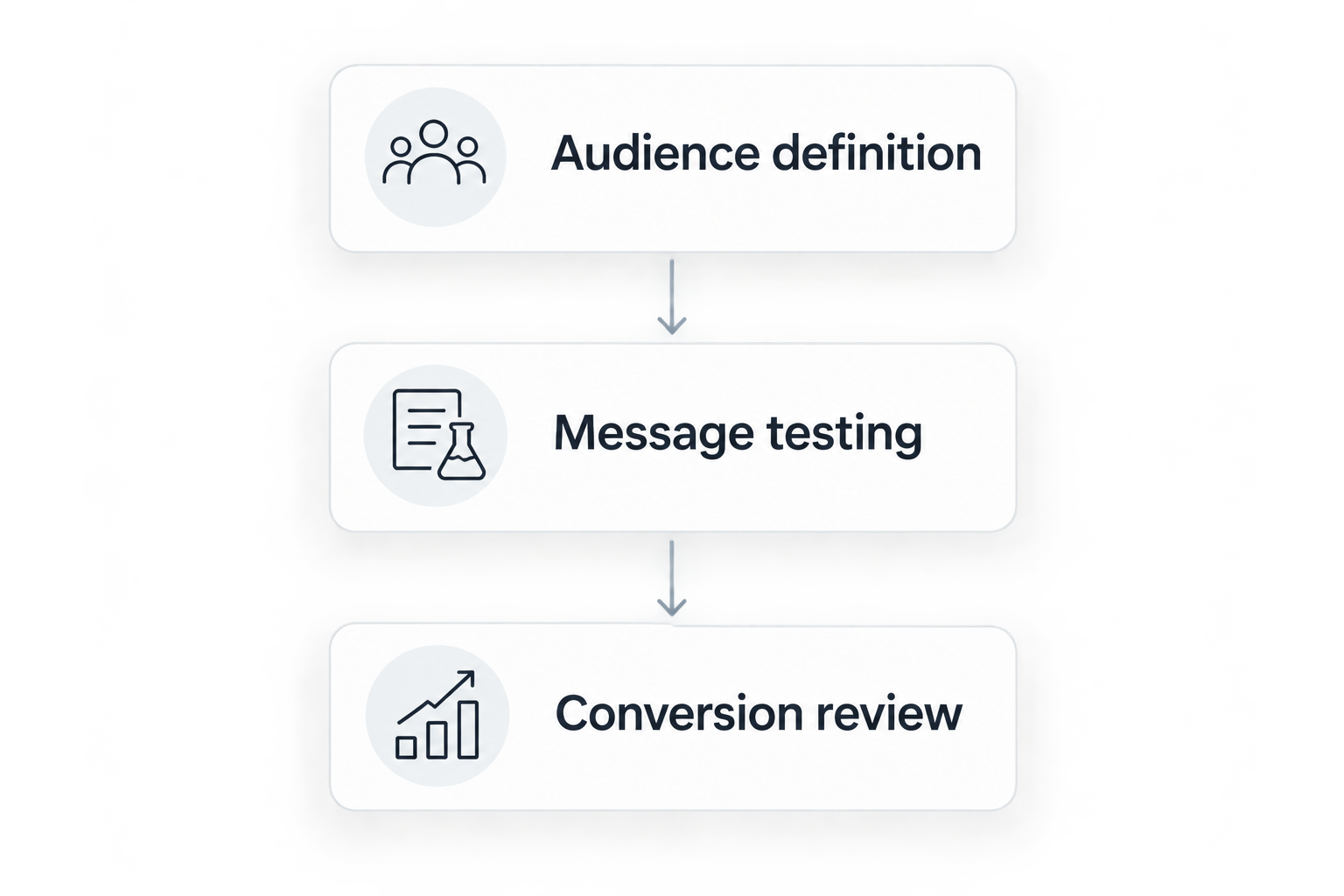
A useful brief connects the announcement, intended audience and conversion journey. Structure the work into 3 campaign stages so each decision has an owner and a clear purpose.
Audience definition
Name the buyer or user you need: collectors interested in the artwork, players interested in the game, or members interested in the underlying access. Specify relevant markets and languages instead of treating crypto as a single global audience.
Teams targeting the UAE, Singapore, Russia, Hong Kong, South Korea, Thailand, Taiwan, China, the US or UK should ask about audience access, language suitability and applicable advertising restrictions. Do not assume that a provider supports every market or every NFT promotion.
Message testing
Prepare 2 creative variants with different messages but the same destination and intended action. This is a starting test design, not a promised performance advantage.
For example, a blockchain game can compare a gameplay-led message with an ownership-led message. Keep the landing page clear about what exists now, what the NFT provides and what the visitor must do next.
Conversion review
Choose 1 primary conversion event before launch. Use secondary actions for diagnosis, not as interchangeable proof of success.
If your goal is a completed registration, do not judge the campaign only by visits. If your goal is a purchase, distinguish a wallet connection from a completed transaction and verify the tracking path before distribution begins.
Where press release distribution fits
MediaX is best for NFT teams seeking press release distribution, not an advertising network. Use that distinction when deciding whether your immediate problem is announcement distribution or paid audience acquisition.
MediaX provides PR and press release distribution for Web3, DeFi, crypto and blockchain projects. For an NFT launch, that service category fits a factual announcement; it does not replace ad targeting, creative testing or conversion measurement.
The advantage of PR is a format for explaining the announcement and its context. The limitation is equally clear: distributing a release does not establish independent editorial endorsement, collector demand or advertising performance.
When evaluating MediaX PR packages, compare the agreed publication scope, reporting and delivery deadline. Competitive value and publishing on time should be explicit buying criteria, without assuming that the lowest quote or the largest outlet list is the best fit.
Send your announcement, target markets and required publication date when you discuss your campaign requirements. Ask for written clarification of what is included and how delivery will be reported.
Which NFT advertising network should you choose?
For an undecided buyer in 2026, start with Coinzilla and Bitmedia proposals built from the same brief. Add Cointraffic when you want another placement-led comparison, and consider A-ADS when the Bitcoin-oriented context fits your audience.
Do not commit to every channel at once. Select the proposal that makes the audience, placements, measurement and responsibilities clearest; reject a proposal that substitutes broad exposure claims for those details.
Keep press release distribution as a separate decision. It supports announcement communication, while your advertising plan must stand on its own acquisition logic.
FAQ
What are the best NFT advertising networks in 2026?
Coinzilla, Bitmedia, Cointraffic and A-ADS are options to shortlist for NFT advertising. Choose through current proposals that explain audience fit, eligible creative, placement scope and measurement rather than assuming a universal performance winner.
Is Coinzilla better than Bitmedia for an NFT launch?
Neither is established as universally better for NFT launches here. Give Coinzilla and Bitmedia the same campaign brief, then compare their proposed placements, measurement and delivery responsibilities.
Can an NFT project advertise through a crypto advertising network?
An NFT project must confirm eligibility with the chosen network before booking. Submit the landing page, creative and promotional claims, and check requirements for each target market.
Should I choose NFT advertising or press release distribution?
Choose advertising for paid promotional placements and press release distribution for communicating a factual announcement. The channels serve different purposes and need separate deliverables and evaluation criteria.
Does MediaX operate an NFT advertising network?
MediaX provides crypto PR and press release distribution services. Evaluate it for announcement distribution rather than assuming it provides advertising network inventory or campaign targeting.
What should I measure in an NFT advertising campaign?
Measure the primary conversion that matches your business objective. Treat impressions, clicks and wallet connections as separate steps rather than equivalent evidence of completed purchases or qualified registrations.
Does an NFT advertising campaign guarantee sales?
No advertising placement guarantees NFT sales. Evaluate the campaign against a defined conversion goal, and assess the landing page, proposition and user journey alongside the traffic.
One last thing
Ask every shortlisted provider the same question: What exactly will the final campaign report allow me to verify? A clear answer should connect the agreed delivery scope to evidence you can inspect—not merely repeat the campaign pitch.
For your 2026 launch, settle that question before approving distribution. Reporting is part of what you are buying, not an administrative detail to resolve afterward.